
University of Michigan
Co-curricular Transcript
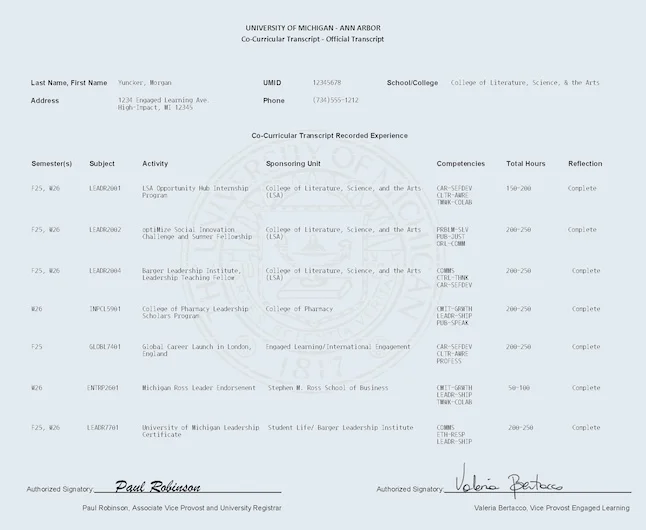
The Co-Curricular Transcript (CCT) at the University of Michigan is an official university document created to recognize transformative experiences beyond the classroom. It highlights significant university-sponsored activities, such as research, internships, study abroad, and community service that enrich students’ lives, foster personal growth, and prepare Wolverines for their next steps after graduation.
Several university offices participated in the pilot phase launched in Fall 2025, with the first CCTs becoming available in Spring 2026. The CCT provides students a valuable tool to document and communicate the full scope of their Michigan experience, supporting future opportunities and illustrating the benefits of engaged and experiential learning.
The CCT complements, but is distinct and separate from, the academic transcript. It does not modify or affect the academic transcript in any way, and students may request the academic transcript, the CCT, or both. The CCT is released to students upon request.
Important Dates
Activities will be validated the first of each month. Students who add activities will be placed in a holding queue before validation occurs, after their activity will be added to the transcript.
Validation Dates:
- (Fall – October 1, November 1, December 1, Jan 15)
- (Winter – Feb 1, March 1, April 1, May 15)
- (Summer – July 1, August 1, Sept 1)
For Students:
- Co-Curricular Transcripts can be requested at any time.
- However, activities cannot be added to the CCT until it has been validated.
- Wait times can vary between 1 week – 1 month depending on if students have had their activity validated previously.
For Faculty & Staff:
- Activities may be added by faculty and staff at any time, decisions are made on a monthly basis by the governance committee.
- They will also be placed in a holding queue until there has been a decision made.
Students: Add an Activity or Request Your CCT
Faculty & Staff: Submit an Activity Proposal
Approved Activities and Competencies
Here you will find descriptions of the approved CCT Activities and the Competencies.
*Both have been identified and provided by the activity leads.
Current List of Approved Activities
Updated, October 14, 2026
Public Service Intern Program PSIP prepares undergraduates for impactful public service careers through summer internships in Washington, DC, Lansing, and beyond. Students gain career skills, alumni and employer connections, campus community, and summer support resources to launch careers in government and public service.
Applied Sport Science Technology Assistant Applied Sport Technology Assistants support sport performance operations managing wearable devices, tagging practices and games, cleaning data, and ensuring accurate performance datasets through field-based work with athletic teams. This role is a
partnership with HPSSC and U-M Athletics.
SLC Study Group Facilitator Undergraduate students facilitate weekly collaborative study groups for peers in introductory STEM courses. Facilitators guide groups of 8-15 students through structured problem-solving, collaborative learning activities, and course material review.
LSA Opportunity Hub Internship Program The Hub’s internship program empowers LSA students to build professional skills through paid, meaningful work that supports the professional development of 20,000 LSA students. Interns contribute to coaching, outreach, research, and program development while gaining mentorship, leadership experience, and a supportive community that helps them grow with purpose and confidence.
OptiMize Social Innovation Challenge and Summer Fellowship The optiMize Social Innovation Challenge (SIC) brings together students working on self-directed projects for positive social impact. Over the course of five months, participants engage in a co-curricular experience where they are introduced to a curriculum rooted in social innovation and human-centered design methodologies. The optiMize Summer Fellowship is an 8-week extension program for funded students to work on their social innovation ventures, supplemented with mentorship and co-curricular programming.
Barger Leadership Institute, Leadership Teaching Fellow Leadership Teaching Fellows co-facilitate ALA 174 and ALA 275, coach project teams, give feedback on assignments, lead mindfulness and contemplative practice activities, and host office hours. In addition, they also facilitate leadership workshops for other units on campus, host podcasts and are recruited for other public speaking activities in support of the work of the BLI.
Michigan Ross Leader Endorsement A micro-credential in leadership that Michigan Ross students can obtain with a 360 skill assessment, attendance at co-curricular workshops, asynchronous behavior change and reflections, for-credit courses, and a capstone project. The MRLE synthesizes student leadership learning across several high-impact practices offered at Michigan Ross.
College of Pharmacy Leadership Scholars Program The PharmD Leadership Scholars Program (LSP) is a co-curricular program that supplements traditional leadership activities embedded in the curriculum to enhance scholars’ professional development and leadership skills. The goal of this program is to prepare students for leadership roles.
Global Career Launch in London, England Students practice their networking skills on a global stage, gaining first hand exposure to international professional environments. The program includes scheduled meetings and networking events with U-M alumni based in the UK, as well as opportunities to explore cultural contexts that shape global networking norms. This enables students to expand their horizons, build cross-cultural competencies, and establish an international network.
Science and Learning Center Peer Tutors Undergraduate peer tutors support students in introductory natural science courses through appointment-based and drop-in sessions. Tutors guide students using questioning strategies, problem-solving techniques, and study skills development to build confidence and independence.
Science and Learning Center Tutor Team Leader Tutor Team Leaders provide guidance and support to undergraduate peer tutors who work with students in introductory natural science courses. In addition to the tutoring responsibilities, Team Leaders mentor a group of 10–13 tutors, observe their sessions, provide feedback and evaluation, and help build a supportive tutor community. They play an important role in helping tutors strengthen their use of questioning strategies, problem-solving techniques, and study skills support so they can better help students build confidence and independence.
University of Michigan Leadership Certificate The Leadership Certificate is an accessible pathway for undergraduates to learn, develop, and reflect on their leadership at the University of Michigan. Students will join a cohort dedicated to completing coursework, co-curricular experiences, and engagement in service, student employment or student organizations with the emphasis on formalizing their leadership experience.
Competencies
The list of competencies is a combined list derived from the National Association of Colleges and Employers (NACE), Association of American Medical Colleges (AAMC) and the American Bar Association (ABA).
NACE
Career & Self Development Proactively develop oneself and one’s career through continual personal and professional learning, awareness of one’s strengths and weaknesses, navigation of career opportunities, and networking to build relationships within and without one’s organization.
Communication Clearly and effectively exchange information, ideas, facts, and perspectives with persons inside and outside of an organization.
Critical Thinking Identify and respond to needs based upon an understanding of situational context and logical analysis of relevant information.
Equity & Inclusion Demonstrate the awareness, attitude, knowledge, and skills required to equitably engage and include people from different local and global cultures. Engage in anti-oppressive practices that actively challenge the systems, structures, and policies of racism and inequity.
Leadership Recognize and capitalize on personal and team strengths to achieve organizational goals.
Professionalism Knowing work environments differ greatly, understand and demonstrate effective work habits, and act in the interest of the larger community and workplace.
Teamwork Build and maintain collaborative relationships to work effectively toward common goals, while appreciating diverse viewpoints and shared responsibilities.
Technology Understand and leverage technologies ethically to enhance efficiencies, complete tasks, and accomplish goals.
AAMC
Commitment to Learning and Growth Practices continuous personal and professional growth for improvement, including setting and communicating goals for learning and development; reflects on successes, challenges, and mistakes; pursues opportunities to improve knowledge and understanding; and asks for and incorporates feedback to learn and grow.
Cultural Awareness Appreciates how historical, sociocultural, political, and economic factors affect others’ interactions, behaviors, and well-being; values diversity; and demonstrates a desire to learn about different cultures, beliefs, and values.
Cultural Humility Seeks out and engages diverse and divergent perspectives with a desire to understand and willingness to adjust one’s mindset; understands a situation or idea from alternative viewpoints; reflects on one’s values, beliefs, and identities and how they may affect others; reflects on and addresses bias in oneself and others; and fosters a supportive environment that values inclusivity.
Empathy and Compassion Recognizes, understands, and acknowledges others’ experiences, feelings, perspectives, and reactions to situations; is sensitive to others’ needs and feelings; and demonstrates a desire to help others and alleviate others’ distress.
Ethical Responsibility to Self and Others Behaves with honesty and integrity; considers multiple and/or conflicting principles and values to inform decisions; adheres to ethical principles when carrying out professional obligations; resists pressure to engage in unethical behavior; and encourages others to behave honestly and ethically.
Interpersonal Skills Demonstrates an awareness of how social and behavioral cues affect people’s interactions and behaviors; adjusts behaviors appropriately in response to these cues; recognizes and manages one’s emotions and understands how emotions impact others or a situation; and treats others with dignity, courtesy, and respect.
Oral Communication Effectively conveys information to others using spoken words and sentences; actively listens to understand the meaning and intent behind what others say; and recognizes potential communication barriers and adjusts approach or clarifies information as needed.
Reliability and Dependability Demonstrates accountability for performance and responsibilities to self and others; prioritizes and fulfills obligations in a timely and satisfactory manner; and understands consequences of not fulfilling one’s responsibilities to self and others.
Resilience and Adaptability Perseveres in challenging, stressful, or ambiguous environments or situations by adjusting behavior or approach in response to new information, changing conditions, or unexpected obstacles, and recognizes and seeks help and support when needed; recovers from and reflects on setbacks; and balances personal well-being with responsibilities.
Service Orientation Shows a commitment to something larger than oneself; demonstrates dedication to service and a commitment to making meaningful contributions that meet the needs of communities.
Teamwork and Collaboration Collaborates with others to achieve shared goals and prioritizes shared goals; adjusts role between team member and leader based on one’s own and others’ expertise and experience; shares information with team members and encourages this behavior in others; and gives and accepts feedback to improve team performance.
Quantitative Reasoning Applies quantitative reasoning and appropriate mathematics to describe or explain phenomena in the natural world.
Scientific Inquiry Applies knowledge of the scientific process to integrate and synthesize information, solve problems, and formulate research questions and hypotheses; is facile in the language of the sciences and uses it to participate in the discourse of science and explain how scientific knowledge is discovered and validated.
Written Communication Effectively conveys information to others by using written words and sentences.
ABA
Problem Solving You should seek courses and other experiences that will engage you in critical thinking about important issues, challenge your beliefs and improve your tolerance for uncertainty and criticism. Your legal education will demand that you structure and evaluate arguments for and against propositions that are susceptible to reasoned debate. Good legal education will teach you to “think like a lawyer”, but the analytic and problem solving skills required of lawyers are not fundamentally different from those employed by other professionals. Your law school experience will develop and refine those crucial skills, but you must enter law school with a reasonably well developed set of analytic and problem solving abilities.
Critical Reading Preparation for legal education should include substantial experience at close reading and critical analysis of complex textual material, for much of what you will do as a law student and lawyer involves careful reading and comprehension of judicial opinions, statutes, documents, and other written materials. You can develop your critical reading ability in a wide range of experiences, including the close reading of complex material in literature, political or economic theory, philosophy, or history. The particular nature of the materials examined is not crucial; what is important is that law school should not be the first time that you are rigorously engaged in the enterprise of carefully reading and understanding, and critically analyzing, complex written material of substantial length.
Writing and Editing Legal education will provide you with good training in writing, and particularly in the specific techniques and forms of written expression that are common in the law. Fundamental writing skills, however, must be acquired and refined before you enter law school. You should seek as many experiences as possible that will require rigorous and analytical writing, including preparing original pieces of substantial length and revising written work in response to constructive criticism.
Oral Communication and Listening The ability to speak clearly and persuasively is another skill that is essential to your success in law school and the practice of law. You must also have excellent listening skills if you are to understand your clients and others with whom you will interact daily. As with writing skills, legal education provides excellent opportunities for refining oral communication skills, and particularly for practicing the forms and techniques of oral expression that are most common in the practice of law. Before coming to law school, however, you should seek to develop your basic speaking and listening skills, such as by engaging in debate, making formal presentations in class, or speaking before groups in school, the community, or the workplace.
Research Although there are many research sources and techniques that are specific to the law, you do not have to have developed any familiarity with these specific skills or materials before entering law school. However, it would be to your advantage to come to law school having had the experience of undertaking a project that requires significant library research and the analysis of large amounts of information obtained from that research.
Organization and Management To study and practice law, you are going to need to be able to organize large amounts of information, identify objectives, and create a structure for applying that information in an efficient way in order to achieve desired results. Many law school courses, for example, are graded primarily on the basis of one examination at the end of the course, and many projects in the practice of law require the compilation of large amounts of information from a wide variety of sources. You are going to need to be able to prepare and assimilate large amounts of information in an effective and efficient manner. Some of the requisite experience can be obtained through undertaking school projects that require substantial research and writing, or through the preparation of major reports for an employer, a school, or a civic organization.
Public Service and Promotion of Justice Each member of the legal profession should be dedicated both to the objectives of serving others honestly, competently, and responsibly, and to the goals of improving fairness and the quality of justice in the legal system. If you are thinking of entering the legal profession, you should seek some significant experience, before coming to law school, in which you may devote substantial effort toward assisting others. Participation in public service projects or similar efforts at achieving objectives established for common purposes can be particularly helpful.
Relationship-building and Collaboration To take full advantage of your legal education, and to become a successful legal professional, it is important to develop the skills that will enable you to work as part of a team and to build relationships with others. Many law school courses are designed to require working as part of a team. Much of the work that lawyers do, whether in practice or in other settings, requires collaborating with others. Moreover, these interpersonal skills are essential for attracting and working productively with clients, co-counsel, opposing attorneys, expert witnesses, and many others.
Background Knowledge There are some basic areas of knowledge that are helpful to a legal education and to the development of a competent lawyer. Some of the types of knowledge that would maximize your ability to benefit from a legal education include: – A broad understanding of history, including the various factors (social, political, economic, and cultural) that have influenced the development of our society in the United States. – A fundamental understanding of political thought and of the contemporary American political system. – Some basic mathematical and financial skills, such as an understanding of basic pre-calculus mathematics and an ability to analyze financial data. – A basic understanding of human behavior and social interaction. – An understanding of diverse cultures within and beyond the United States, of international institutions and issues, of world events, and of the increasing interdependence of the nations and communities within our world.
Exposure to the Law There are many good reasons to explore the law and the legal profession before entering law school. You will gain a more realistic view of the actual practice of law, the skills you will need, and the realities of the legal employment market. Greater familiarity with the legal system—its institutions, concepts, and even vocabulary—can advance your understanding of law school curriculum. You may identify potential practice areas that suit your personality, interests, and values. You may even enhance your candidacy for admission to law school, as well as your opportunities for employment during and after law school.
Additional Committee Approved Competencies
Public Speaking and Presenting The ability to plan, structure, and deliver clear, engaging messages to an audience using effective verbal/nonverbal communication and visuals as needed while adapting to the audience and handling questions confidently.
Frequently Asked Questions
Below you will find key information about the Co-Curricular Transcript (CCT), how to add activities, and how to request and receive your CCT.
What is the Co-Curricular Transcript (CCT)?
The CCT is an official University of Michigan–Ann Arbor document that records approved, university-sponsored, non-credit co-curricular experiences completed while you’re enrolled (recording begins Fall 2025). Only experiences approved through the CCT process can appear.
How is the CCT different from my academic transcript?
Your academic transcript lists coursework and grades. The CCT lists approved co-curricular experiences. They are separate transcripts, and requesting one does not affect the other.
Will adding an experience to my CCT affect my academic transcript or GPA?
No. The CCT does not change your academic transcript in any way.
What counts as a co-curricular experience for the CCT?
An eligible experience must be university-sponsored, organized, and supervised by a U‑M office or employee and include at least 50 hours of active engagement (reported in hour ranges). Examples may include research, internships, study abroad, and community service. Credit-bearing coursework is not included.
Are student organization leadership roles included?
Not during the pilot phase. Leadership roles in recognized student organizations (SSOs) are also currently not included.
When does CCT recording start, and can earlier participation appear?
CCT recording begins Fall 2025. Participation prior to Fall 2025 may not appear on the CCT, even if you started an experience earlier.
What are the pilot program dates and special rules?
- Pilot dates: August 25, 2025 – April 30, 2026
- To be included, you must complete the experience in Fall 2025 or later (you may have started earlier, but you cannot have completed it before Fall 2025).
- Eligible: Started Spring 2024, completed Fall 2025 → may be included
- Not eligible: Completed Spring 2025 → may NOT be included
What information appears on my CCT?
Your CCT includes your name and university identifiers and, for each validated activity: experience code/subject, title, sponsoring unit, competencies, an hours range, the semester(s) participated, and if the activity had a reflection component.
- Subject/Code: The letters/numbers used to identify and track an activity on the CCT.
- Sponsoring Unit: The U‑M school/college/unit responsible for the activity and its validation.
- Semester(s) Participated: It lists the semester(s) the activity occurred as recorded for the CCT. If you participated earlier than Fall 2025, those earlier semesters may not be shown.
- Hours: Hours are listed as a range (e.g., 50–100, 100–200, 200–250, 200+). Ranges standardize reporting across many types of activities rather than tracking exact hours.
- Competencies: Each activity lists 1–3 competencies (skills/attributes developed). The CCT uses abbreviations (e.g., COMMS), and the appendix includes the full names. Competencies may align with frameworks such as NACE, AAMC, ABA, and AACE, or other committee-approved competencies.
- Reflection: Most activities include a required reflection/assessment (e.g., exit interview, essay, presentation, project, or module).
How are experiences approved, added, and validated?
- A U‑M unit proposes an activity using the CCT template.
- The CCT Governance Committee reviews and approves it for inclusion.
- You (the student) add activities to your CCT from the approved list through the “Add an Activity or Request Your CCT” on the Engaged Learning Website. Activities can be requested for addition to your CCT at any time.
- The activity lead (designated U‑M employee) verifies your completion. Validated experiences are then officially added to your CCT.
*validation typically takes place twice per semester.
Can I remove an experience after it’s been added?
No. Once an activity is validated and posted to your CCT, it cannot be removed.
What if my activity isn’t listed as an option to add?
Submit a request through “CCT Activity Proposal Submission Form” → “I am a Student” and complete the form. The office will contact the activity lead for details and send the experience through Governance Committee review. You’ll be notified whether it is approved or denied.
Who manages the CCT?
- The CCT Governance Committee approves experiences and sets standards for fairness and consistency.
- The administrative office manages approved-experience records, CCT requests, and the validation workflow.
How do I request my CCT, and how long does it take?
Request your CCT using the “Request My Co-curricular Transcript” form and log in with your U‑M credentials. Processing is typically 1–2 weeks (often within one week).
CCTs can be requested for download any time after April 1, 2026.
Can I send my academic transcript and CCT together to an employer or graduate school?
Unfortunately, at this time the documents will have to be sent separately, for them to be “official”. The Office of Engaged Learning will digitally deliver your “Official curricular Transcript” to your recipients of choice as a seperate process than what the Registrar’s Office currently follows.
Is the CCT an official transcript?
Yes. It is issued as an official university transcript document and includes an authorized signatory.
Will my CCT update if I complete more experiences later?
Yes! Your CCT reflects validated information as of the date issued. If you validate additional activities, request a new CCT to receive an updated copy.
What if something on my CCT is incorrect?
Do not edit the document. Contact the CCT office (Office of Engaged Learning/administrative team) so they can review validation details with the sponsoring unit/activity lead and correct it through the official process.
How is privacy handled? Who can see my CCT?
You choose when and whether to request and share your CCT with third parties. Requests are handled by the Domestic Engaged Learning Team (Provost’s Office) in partnership with the Registrar. Records are protected under FERPA and university policies.
How is the CCT reviewed and improved?
The CCT is reviewed annually, and student and campus feedback is used to improve the process.